


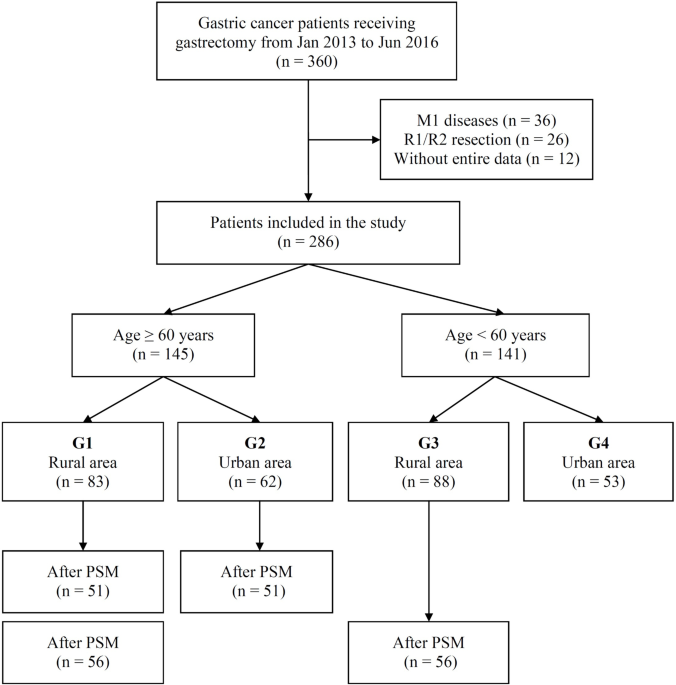
The present study found that OS of rural older gastric cancer patients was significantly inferior to that of their urban older and rural younger counterparts, which was confirmed by controlling for confounding factors through PSM analysis. We explored the potential factors contributing to this disparity through comparing the clinicopathological features across different groups and performing Cox regression analysis. The study did not attribute the differences in OS between rural and urban older patients to delayed diagnosis or advanced TNM stage in rural patients. Instead, the analysis revealed that rural older patients were more likely to have upper stomach cancers and undergo total gastrectomy, while less likely to receive adequate adjuvant chemotherapy compared to their urban older or rural younger counterparts. These factors may have contributed to the increased fatality rates observed in rural older patients.
The identification of age as an independent prognostic factor in patients undergoing curative-intent therapy for stomach cancer is consistent with previous studies16,17,18. However, the current study found that there was no significant difference in OS between urban older patients and urban or rural younger patients. Indeed, advancements in surgical techniques, including the use of minimally invasive surgery and lymph node dissection preserving the spleen and pancreas, have made age no longer a limiting factor in radical gastrectomy. Gastrectomy with lymph node dissection did not significantly increase postoperative complications in older patients. However, older patients still had worse OS outcomes after both D1 and D2 lymph node dissection compared to younger patients, and D2 dissection did not provide a significant survival benefit for older patients19,20,21,22. This indicates that the poor prognosis in older patients cannot be solely attributed to the surgical procedure itself, but rather to other factors that may accompany aging, such as functional status, comorbidities, nutritional status and frailty23,24. The older patients in this study exhibited higher ASA scores, a lower proportion of high BMI, and more cases of hypoproteinemia, highlighting the importance of comprehensive assessments of older patients in the perioperative period. These factors can impact the patient’s ability to tolerate treatment, recover from surgery, and ultimately affect their overall prognosis. Therefore, it is crucial to consider these additional conditions and factors when managing older patients with stomach cancer to optimize outcomes and provide appropriate support during the treatment process24.
Gastric cancer can be categorized into two topographical subsites, the cardia (upper stomach) and noncardia (lower stomach), each with distinct risk factors, carcinogenesis, epidemiologic patterns and prognosis25. Upper stomach cancer, typically located in the cardia region, is associated with specific characteristics that may correlate with a worse prognosis compared to lower stomach cancer. Patients with upper stomach cancer often present with a higher prevalence of males, older age, and more advanced pathological stages upon diagnosis26,27. These less favorable clinicopathological features can significantly impact treatment options and overall prognosis26,27,28. In particular, patients with advanced upper stomach cancers are more likely to undergo total gastrectomy, which can have profound effects on dietary intake, nutritional status, psychological well-being and quality of life, potentially reducing their ability to tolerate postoperative adjuvant chemotherapy29,30,31,32,33,34,35. It’s noteworthy that rural older patients had the highest proportion of upper stomach cancer and total gastrectomy in the present study. This finding suggests that this particular patient population may face unique challenges and considerations when it comes to managing upper stomach cancer36,37. The combination of advanced disease stage, total gastrectomy, and challenges in receiving and tolerating adjuvant chemotherapy among rural older patients may explain the observed differences in prognosis compared to other groups.
Several phase III randomized controlled trials have demonstrated that postoperative adjuvant chemotherapy could significantly improve OS and RFS in patients with advanced gastric cancer who had undergone D2 gastrectomy38,39. Furthermore, the study highlighted the importance of relative dose intensity in determining treatment effectiveness, with higher intensity correlating with better outcomes39. Adherence to treatment protocols is highlighted as essential for maximizing therapeutic benefits, as the completion and intensity of chemotherapy significantly impact its efficacy40,41. The present study identified adjuvant chemotherapy and relative dose intensity as independent prognostic factors, further emphasizing their influence on patient outcomes. Concerningly, rural older patients had lower rates of receiving adjuvant chemotherapy and completing the recommended number of cycles compared to other groups. This disparity in treatment access and adherence could be a key factor contributing to the poorer prognosis observed in this patient population.
Rurality may have a detrimental impact on the long-term prognosis of cancer patients42,43. Living in rural areas is usually associated with an unhealthy diet, poor health awareness, lower socioeconomic status, and limited accessibility to health care. The rural population is known to have limited access to fresh healthy foods, leading to a higher consumption of processed and unhealthy foods. Rural residents in Sichuan, particularly older persons, tend to have dietary preferences for salted meat, Chinese bacon (a special type of processed meat made from cured meat that is then smoked and exposed to the sun), sausage and pickled vegetables, which have been linked to higher gastric cancer mortality rates44,45,46. The older patients in this study were mostly born in the 1940s and 1950s, and had very limited education, especially in rural areas, leading to low health literacy and making it difficult for them to comprehend medical information, adhere to treatment plans, and make informed decisions about their care. In rural areas, older individuals often hold strong beliefs in traditional Chinese medicine and certain health and dietary concepts, which may hinder their willingness to receive adequate modern anti-tumor treatments47,48. Rural areas often have fewer healthcare facilities, medical professionals, and specialized cancer treatment centers, which coupled with poverty and limited access to healthcare facilities exacerbates disparities in cancer treatment outcomes49,50,51,52. Additionally, other potential explanations such as genetic predisposition and environmental factors cannot be ruled out, which may influence the aggressiveness of gastric cancer and the response to treatment. To improve gastric cancer outcomes, it is essential to address these disparities and enhance access to healthcare, education, and resources in rural communities53.
With the acceleration of urbanization, the phenomenon of left-behind older people in Sichuan is becoming increasingly prominent, potentially accounting for half of the total older population54. This situation poses unique challenges and implications for the well-being and quality of life of the older population in rural China13. The left-behind older population are particularly vulnerable when faced with a diagnosis of gastric cancer and may encounter physiological, psychological, social and financial difficulties and challenges, which can impact treatment and recovery from gastric cancer55. The left-behind older patients may face challenges in treatment compliance due to lack of family support and care. Facing the stress and anxiety of a gastric cancer diagnosis and treatment process, the left-behind older patients may lack necessary psychological and social support, which can impact their emotional well-being and recovery process They may face challenges such as traveling long distances for medical care, financial burdens related to medical expenses, difficulties in obtaining medical information, which can affect their ability to receive proper treatment and manage their condition.
Addressing the needs and challenges of rural older patients in China requires a comprehensive and multi-sectoral approach that involves government agencies, healthcare providers, social service organizations, community groups, and policymakers. Several concrete steps can be taken in clinical practice. Firstly, targeted screening programs should be implemented in rural areas to increase early detection rates. These programs can include regular endoscopic examinations and educational campaigns to raise awareness about the symptoms of gastric cancer. Secondly, financial support initiatives should be developed to help rural patients afford the costs of treatment. This can include subsidies for medical expenses and transportation costs to healthcare facilities. Thirdly, efforts should be made to improve rural healthcare infrastructure, such as training more healthcare providers and equipping rural hospitals with advanced diagnostic and treatment equipment. These measures can help ensure that rural patients have timely access to high-quality care. Thus, we can help improve their treatment outcomes and quality of life, enabling them to better cope with the challenges of gastric cancer.
The study had several limitations that should be considered when interpreting the results. Firstly, the study was conducted at a single center, which may limit the generalizability of the findings to a broader population. While these results provided valuable insights into regional disparities, they may not be universally applicable due to the unique socioeconomic and healthcare context of Sichuan. Further studies using external datasets or through multicenter trials are needed to validate these findings in other regions and to explore proactive strategies, such as targeted screening programs and improved access to adjuvant chemotherapy, to address these disparities. Secondly, the retrospective nature of the study may introduce potential bias and confounding variables that were not accounted for in the analysis. The lack of detailed information on socioeconomic status, educational level, and nutritional status scores is a significant limitation. These unmeasured confounders might play a crucial role in influencing treatment access and outcomes in patients with gastric cancer, and their absence in the study limited the understanding of the full spectrum of factors contributing to the observed disparities in outcomes. Thirdly, the small sample size of the study may also impact the statistical power and reliability of the results. Fourthly, there’s a potential for misclassification of rural versus urban residence, as some patients may have moved between these areas or may have been inaccurately classified based on their registered permanent address. This misclassification could affect the observed associations between residence and survival outcomes. Additionally, self-selection bias in healthcare-seeking behavior may have influenced the results, as patients who seek medical care may differ systematically from those who do not. Thus, future research with larger sample sizes, prospective study designs, and comprehensive assessments of relevant factors is warranted to further investigate the relationship between age, rurality and outcomes in patients with gastric cancer.
link