A quasiexperimental study of assessing the impact of stress management program on health science students at Kuwait University
The purpose of this study was to evaluate the effectiveness of a stress management program among HSC students at Kuwait University via a quasiexperimental research design. The rationale for conducting this study is the high prevalence and susceptibility to mental health problems among students (e.g., anxiety, depression, and stress) secondary to academic pressures, social challenges, and future career concerns55. Several studies conducted in the Middle East and North African (MENA) region, including Egypt, Saudi Arabia, Kuwait and the United Arab Emirates, reported high levels of psychological stress, anxiety, and depression among students8,56,57,58. Hence, an emphasis on using comprehensive stress management programs is essential not only for individual well-being but also for fostering a supportive and productive academic community55,59,60,61. As researchers, to overcome the challenges facing university students’ psychological symptoms and ongoing stressful issues, we utilized a stress management program to promote positive mental health outcomes.
Congruent with research, increased worrying and overthinking can lead to mental health issues, creating a cycle of negative thoughts60,61,62. To overcome stress among students, the stress management program provided for the HSC students at Kuwait University included nine areas that are important for potential improvement in mental health, academic performance, skills development, and physical health63,64,65,66. Hence, the primary strategies considered useful by the intervention group were breathing exercises (75%) and self-care (64.3%), which were significant components in reducing stress, anxiety, and depression among students. Similar findings support the hypothesis that deep breathing techniques can help students minimize study-related stress and tension, reduce anxiety and worry and improve concentration63,64,65. Additionally, self-care activities can further influence positive habit formation, desired behavioral changes, and promoting resilience during stressful life events66. It was also found to be an ethical imperative for psychology students, as it can mitigate the adverse effects of stress on professional functioning and health during the later stages of their careers62.
As demonstrated in this study, the high frequency of lack of interpersonal skills (i.e., relationships and communication with others), lack of family support and lack of psychological symptoms associated with this stage of education interfered with well-being and one’s own realization of true potential. Further research has shown that incorporating resilience and mindfulness techniques, along with other methods, should concentrate on acquiring knowledge and highlight a human-centered interpersonal aspect of personal development59,67. Our research included these interventions, such as coping strategies and psychoeducation, and emphasized the importance of mindfulness interventions in these programs. Mindfulness is associated with decreased maladjustment and heightened adaptive social behaviors67,68. Additionally, mindfulness programs have been shown to enhance students’ resilience and help them adopt effective coping strategies68,69. Resilience remains consistent across different situations and environments, regardless of individual variations. Positive thoughts, problem-solving strategies, and seeking support are all closely connected, making it the most significant factor in mental well-being69.
This program demonstrated effectiveness in the experimental group, as our results revealed improvements in the intervention group, with reduced stress (p value = 0.02*), depression (p value < 0.01*) and anxiety (p value = < 0.01) after completing the program. Additionally, compared with those in the control group, except for anxiety, we found statistically significant differences in the median scores for all outcomes between the control and intervention groups (p values < 0.05). We believe that such a significant difference between the intervention and control groups is because the stress management program could be considered evidence-based and scientifically driven in the future. Therefore, we emphasize the need for HSC students (i.e., all majors) to be taught the importance of stress management programs during their undergraduate training. However, research indicates that it is important for programs to be ongoing and help promote resilience through demonstrating personal competence, self-reliance, independence, and perseverance59,69. University students showed increased resilience after participating in a curriculum that combined traditional teaching with experiential workshops. Implementing mindfulness and resilience strategies in educational settings not only addresses mental health concerns but also promotes a proactive approach to student well-being70. Furthermore, the study findings demonstrated that through planning and prioritizing, students were able to strategize effectively for successful outcomes in what one wanted to accomplish and attain. Thus, more than half of the intervention group (55.4%) reported using planning as an effective strategy to address their mental health problems. These findings are in line with the literature, thus emphasizing its value and effectiveness33. Therefore, faculty members are encouraged to incorporate planning and prioritization as useful learning strategies for their students throughout their educational curriculum due to the desired outcomes. Additionally, approximately one-third of the intervention group (30.4%) supported using positive coping strategies to address their psychological problems. In contrast, when healthy coping mechanisms are absent, students may experience excessive negative emotions and be unable to live healthy lives, thereby impacting their educational outcomes71.
Nevertheless, utilizing positive coping mechanisms for students during their studies is a key factor in reducing stress, promoting better problem-solving skills and leading to enhanced academic performance; this is a well-documented and recognized strategy supported by research38,72,73. However, some students’ personalities, particularly introverts, do not usually seek help when needed. Students tend to underestimate the influence it may have on their psychological status and its effect on academic performance. Thus, positive coping strategies are an invaluable technique when individuals seek help, which consequently increases their confidence levels, improves their emotions and results in receiving guidance and support39,40. Hence, seeking help was one of the main intervention strategies taught to the intervention group participants, who perceived its effectiveness accordingly (28.6%). In turn, motivating students to seek guidance and help whenever needed can contribute significantly to developing better coping strategies for them as students and as future health care professionals.
Additionally, a useful intervention strategy used in our program was psychoeducation (28.6%), as indicated by the experimental group39,50. Hence, such a strategy has been strongly emphasized in the literature, as it encourages students to acquire knowledge about their own needs, identify their priorities and understand their own weaknesses and strengths50,51,52. Students are encouraged to utilize mental health effectively, particularly those presented with emotional difficulties, who therefore exhibit maladaptive coping skills53,74. Additional components of the stress management program, which contributed to the interventions’ positive health and addressed their psychological problems, included engaging in exercise (46.4%) and benefiting from cognitive behavioral therapy tips (41.1%). As cited in the literature, these components are proven to promote health and wellness; minimize stress, anxiety and depression; and improve quality of life75,76,77,78,79,80. Thus, we recommend including these components as major parts of future student counseling services received from faculty members as well as from student affairs centers.
Our findings show that the stress management strategies used in the program incorporated cultural norms and rituals, thus making the program culturally appropriate. For example, students utilized meditation strategies (28.6%) from the program, as the participants were encouraged to combine certain strategies, such as exercise and prayer (i.e., engaging in ten sit-to-stand repetitions after each prayer as Muslims pray five times a day). Additionally, our study focused on reading the Holy Quran as a strategy to reduce psychological symptoms, including stress, anxiety and depressive symptoms, which was also supported by the literature36. A culturally appropriate stress management program was tailored for university students and considered both the unique academic challenges and the cultural backgrounds of the students. The inclusion of cultural components motivated participants to readily and actively engage in the program. As shown in the study results, many respondents indicated that this program was useful and that they would be willing to use it regularly. Contextually relevant indices of positive adaptation must be considered to contextualize the resilience process69. Interestingly, owing to its culture appropriateness, the students indicated the recommended use of the program even well after graduation. Such confidence in and support for this program from the experimental group are clear signals of its utility, appropriateness and value. Notably, after the data collection and analysis, the control group received the stress management program as an online booklet.
Research continues to enhance stress management strategies and programs, resulting in progress within the field59. These findings indicated that many students view overthinking (81.1%) and the college course load (77.6%) as major sources of stress. Despite these findings, the intervention group showed significant improvements in stress (p = 0.02*), depression (p < 0.01*), and anxiety (p < 0.01*) after program completion. The students used a variety of strategies to address mental health problems. Breathing techniques and taking care of oneself were the primary effective methods employed by the intervention group, with 75% and 64.3%, respectively. Additionally, different students found success with a variety of strategies, such as planning and prioritizing, coping strategies, seeking help, meditation, and psychoeducation. Considering the effectiveness of these self-reported approaches, as illustrated in study results, establishing ongoing support in educational settings could help mitigate rising levels of stress66,68. These programs must be accessible, inclusive, and frequently evaluated to meet the diverse requirements of students, aiding in their success both academically and beyond.
Study limitations
This research study has several limitations that deserve attention. Lack of blindness among the groups is a limitation in the study which could have caused bias in the study finding. Hence, Given the nature of the intervention, which is a stress management program involving educational session and behavioral techniques, and this was not feasible to blind the participants or the facilitators, as both were aware of the intervention being delivered. However, we took several steps to minimize potential biases associated with the lack of blinding: (1) Use of validated self-report measures (e.g., Perceived Stress Scale) to standardize outcome assessment and reduce measurement bias; (2) Pre- and post-intervention assessments were conducted using the same tools and conditions for both groups to ensure consistency; (3) Data analysis was conducted by a researcher not involved in the delivery of the intervention, helping to limit analytical bias.
In addition, one of the key design choices in this study was not providing any intervention to the control group. This decision was made to isolate the effects of the stress management program. However, it is important to acknowledge the limitations this introduces. The participants were students living their academic lives without recognizing they had psychological issues such as stress or depression due to educational pressure. As such, providing an alternative intervention was not deemed necessary, and the control group continued their usual activities without any additional intervention.
This approach, while beneficial for isolating the intervention’s effects, may impact the accuracy and generalizability of the results. The lack of a placebo or alternative activity for the control group means that external factors influencing the results cannot be entirely ruled out. Additionally, this design choice may reduce the generalizability of the findings to real-world scenarios where some form of placebo or alternative treatment is often provided. These limitations should be considered when interpreting the study’s outcomes and have been clearly discussed to ensure a comprehensive understanding of the study’s design and its implications.
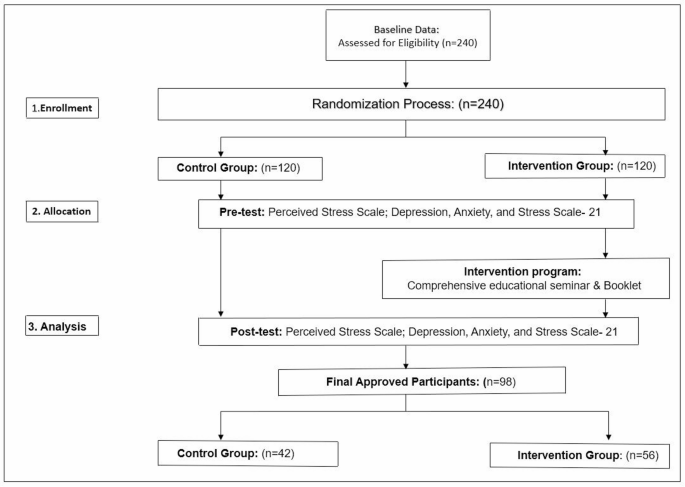
Moreover, the baseline depression score on the DASS-21 was significantly different between the intervention and control groups (P = 0.05), thus causing baseline imbalance. This could be due to the natural variability of the data among the study participants, particularly with the large drop of study participants after the randomization process. To illustrate, since there are a lot of drop-outs of the study participants making the sample less and likely influenced the study findings and analysis; this could possibly be due to the timing of data collection closer to the mid-term examination period where students were quite busy with examinations or homework assignments. Therefore, the study findings relevant to depression between the groups could be biased and thus interpreted with caution. However, the pre- and postintervention depression subscale scores for the intervention group were significantly different (P < 0.01), supporting the value of the stress management program utilized by the intervention group in improving depressive symptoms. Additionally, the program’s outcomes may not be as broadly applicable to a larger population because of the relatively small sample size of HSC students. Notably, it is of importance to indicate that there could be a potential for inflated Type I error due to multiple testings. However, many of the outcomes (e.g., DASS-21 subscales) are conceptually and statistically related, and strict corrections such as Bonferroni may be overly conservative in such contexts, increasing the risk of Type II errors (missing real effects). On the other hand, future studies with larger sample sizes and confirmatory objectives are recommended to apply appropriate corrections for multiple comparisons in the design phase.
Furthermore, as most of the participants involved in the research were students studying physical therapy, there is a potential for bias that could hinder the generalizability of the findings to other health science fields. Therefore, future studies should include larger random samples, which are equally representative samples of students from all majors of the HSC, to ensure more inclusive and generalizable findings. Furthermore, the program’s limited and short duration (4 weeks) may have hindered the development of more significant positive effects. Hence, such short duration could have contributed to the impact of intervention on the level of anxiety among the intervention group. Having said that, future studies conducting stress management programs are recommended to scrutinize the specific rationale for the limited improvement of students’ anxiety; the need for longer duration of stress management program could mitigate the students’ anxiety accordingly. Finally, we provided information on only one orientation session and educational seminar before the program was implemented, and there was no follow-up during the program, thus limiting the measurement of its long-term effectiveness and outcomes.
Study implications and future directions
This study has notable implications and future directions that are worth mentioning. To our knowledge, this is the first intervention study at Kuwait University in which a stress management program was provided for health science students. This study hopes to guide future research on students’ mental health in implementing scientifically driven and culturally appropriate programs. Therefore, university administrations should prioritize mental health and stress management by allocating budgets and resources to stress management programs. Moreover, KU needs to collaborate with mental health professionals, counselors, and wellness coaches to design and deliver such programs. Furthermore, to ensure that counseling services are readily available and promoted to students who need them, faculty and staff should be trained in recognizing signs of stress as an early intervention approach. Following through with supporting steps is crucial for implementation, including examining models that integrate academic advice with mental health counseling to provide holistic and culturally sensitive support for all students.
Additionally, our findings suggest the implications may extend beyond graduation; many of the experimental group participants indicated that they would recommend this stress management program to their future patients. Doing so can improve patients’ psychological symptoms, particularly those who present with high levels of stress or depressive symptoms. Thus, the detailed program is fully accessible for faculty members and health care professionals, allowing its application within educational and clinical settings and leading to beneficial and desirable outcomes. Furthermore, when applying stress management strategies, it is essential to consider the use of evidence-based strategies. To prioritize students’ mental health and well-being, we support integrating stress management into university courses, which is essential for improving students’ academic outcomes and fostering a positive campus environment. However, considering that the cultural context is also invaluable and promotes desired consequences, these programs must be accessible, inclusive, and continuously evaluated to effectively meet the diverse needs of the student population during their academic careers and future endeavors.
Specifically, our findings have implications for stress management programs for HSC students and identify areas for future investigations. Our findings are similar to those of other studies indicating the effectiveness of stress management programs on students’ stress levels23,81. However, further studies may need to investigate the effects of stress management programs on HSC students based on the requirements for each year. It might also be necessary to assess whether the program’s content needs to be changed to better meet the educational needs of the students while considering the necessity of follow-up sessions82. We propose conducting longitudinal randomized controlled trials concerning the effectiveness of stress management programs in the future to validate the results of this study. Standardized and culturally relevant self-reports were used to assess outcome variables thus supporting the validity of the study findings.; hence, additional objective measures for measuring the study outcomes in future studies will minimize bias and ensure more robust study findings.
It would be possible to include this program as an elective course in the university curriculum, giving students the chance to gain knowledge of useful stress reduction strategies. As part of the program, counseling services on campuses are also recommended to assist students in identifying stressors and creating useful coping mechanisms8. Finally, we encourage future studies to replicate the study with a balanced sample (e.g., equal gender representation, broader majors). Thus, in order to minimize the baseline imbalances which could affect the internal validity of the findings, we recommend that future studies adopt true randomized controlled designs to better address this limitation. In addition, we advise future studies to provide a manual or protocol for cultural adaptation to guide future studies, particularly with participants presented with diverse cultural background.
link
:max_bytes(150000):strip_icc()/GettyImages-1353223720-6aa033a7c6414debbec9dbe02bdaeb63.jpg "What Is the Holmes and Rahe Stress Scale?")