
Advanced Practitioner Shares Radiation Oncology Considerations
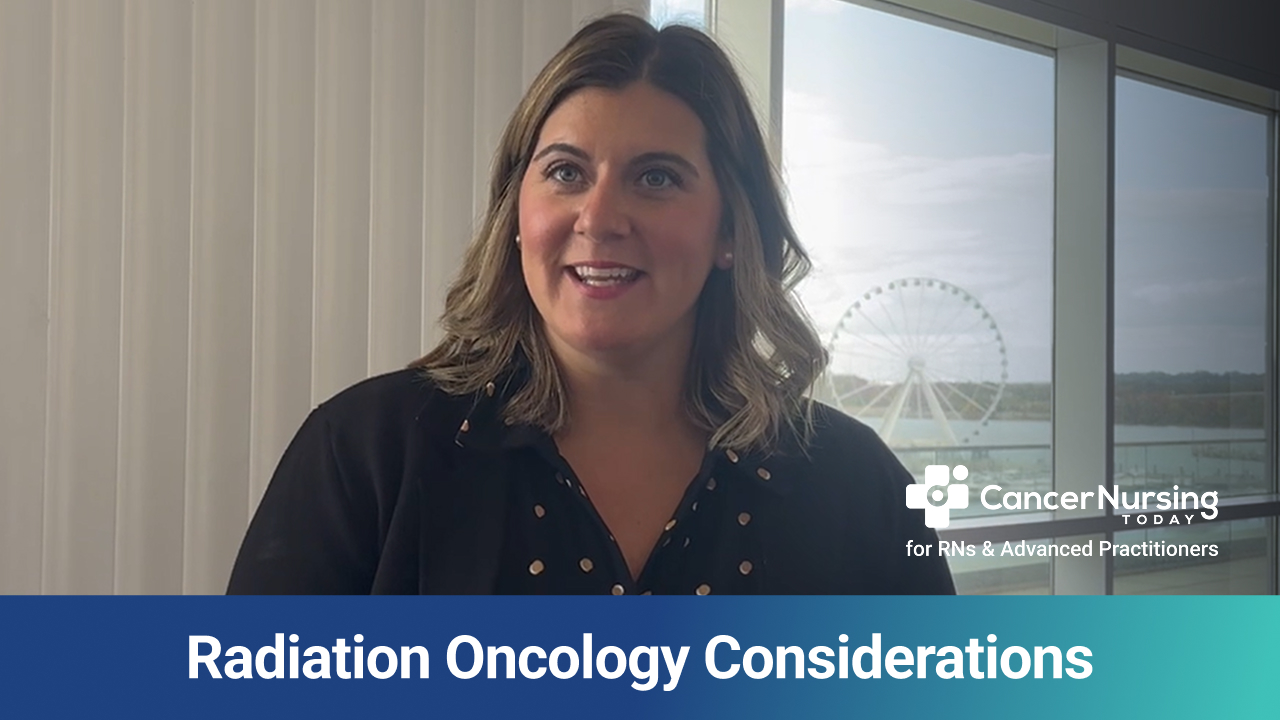
Sarah Anderson, DNP, AGACNP-BC, OCN, WCC, of RUSH MD Anderson Cancer Center, joined Cancer Nursing Today at JADPRO Live, the Annual APSHO Meeting, to share insights on treatment approaches for patients diagnosed with lung cancer and brain metastases, including critical radiation oncology considerations for nurses and the larger multidisciplinary healthcare team.
Watch the video above and read the transcript below to learn more.
TRANSCRIPT:
Often, a lung cancer patient may present with an isolated site of brain metastasis, and that’s still under the paradigm of treating them as an oligometastatic lung cancer patient. They’ll get the standard of care treatment in the lung, and then we’ll treat an area in the brain. How we approach this is multidisciplinary. When someone has a brain metastasis, you want to think about if this is someone who should have a resection. Can we monitor them? What is their overall cancer picture? Are they going to be going on a systemic therapy that penetrates the blood brain barrier? Is it going to penetrate the CNS [central nervous system] with a targeted therapy or immunotherapy? If they have a small, isolated brain metastasis and they’re not having symptoms, but they’re going to start a therapy that has CNS penetration, we may just observe that brain metastasis really closely with brain MRIs at the 2- to 3-month interval.
We also look at the size and the location of the metastasis. If they have non-small cell lung cancer, we know that they may have indolent or slow growth, or they may respond to systemic therapy. We’re not going to put them through radiation unless we find it to be useful. If their lesion is 3 millimeters or less, we consider it quite small and reasonable to monitor, mostly because we want to make sure it is indeed a metastasis. Sometimes, when lesions are really small, that may not always mean they are associated with cancer. If they’re between 3 to 6 millimeters, does it make sense to treat upfront? We wait for a response. If the metastasis is greater than six millimeters, if there’s swelling, if the patient has symptoms, then we need to talk about whether they go to neurosurgery and have the metastasis removed because that’s immediate symptom relief.
Radiation doesn’t offer immediate relief. It can take some time. If the patient is having a lot of symptoms, that’s a tricky spot; we don’t want to wait for radiation to shrink that tumor, and we could cause more swelling as the tumor dies within the brain, which could give the patient more symptoms upfront. We’ll talk to our neurosurgery colleagues, we’ll talk to the medical oncologist, but ultimately, a lot of these patients don’t want to go through surgery, and they don’t want a delay in their systemic therapy, so we treat them with SRS, which is radiosurgery, similar to that in the lung. It’s precise. We can aim it at the lesion. Patients have better overall cognitive tolerance, so there’s not a lot of cognitive deficits or even side effects of the treatment when you’re comparing it to more standard treatment or the whole brain.
Patients do really, really well with the treatment. We have good ablative control, and we can treat up to 10-15 spots, which is great. A lot of the data has suggested that’s effective in progression-free survival and overall survival, so we’re able to target these lesions, and patients can go on to their systemic therapy, and then we monitor them on re-staging scans to make sure they’re doing okay.
link