
Early-Stage Innovation Fund awards advance breakthrough technologies in healthcare, education and security
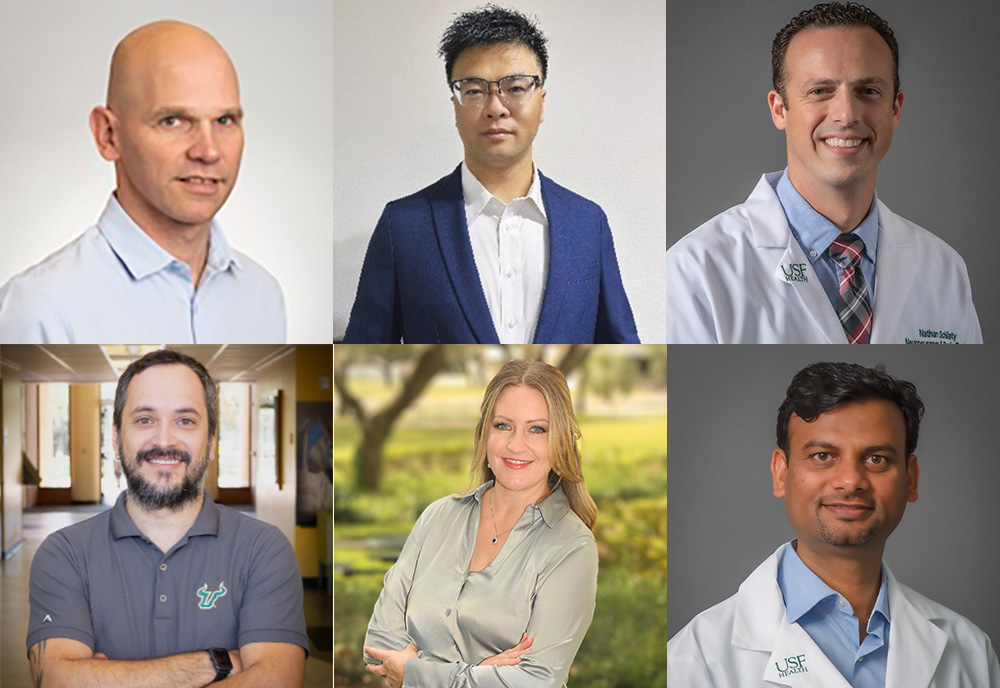
The Florida High Tech Corridor in partnership with University of South Florida Research & Innovation is pleased to announce the latest recipients of the Early-Stage Innovation Fund awards.
This initiative supports pioneering research projects with significant commercial
potential, providing each selected faculty-led team with up to $25,000 in seed funding
to advance their innovations toward market readiness. Past awardees have leveraged
this funding to launch start-up companies, expand industry and community partnerships
and secure more than $650,000 in further investment and grant funding.
The latest awardees reflect the breadth of innovation emerging across the university,
with projects addressing critical global challenges — from advancing healthcare training
and personalized education to revolutionizing diagnostic technologies, wearable rehabilitation,
environmental monitoring and next-generation security solutions.
The awarded projects below are led by faculty from the new Bellini College of Artificial Intelligence, Cybersecurity, and Computing, Morsani College of Medicine, College of Arts & Sciences and College of Education.
Design and Development of ADEPT: A Novel Simulation Design to Expand Access to Comprehensive
Endoscopy Training for Speech Pathologists
Dr. Jamie Toghranegar, Morsani College of Medicine, Department of Otolaryngology
Dr. Howard Kaplan, USF Advanced Visualization Center
The ADEPT (AI-Enhanced Distance-Learning Endoscopic Performance Trainer) is a novel
simulation design for training speech-language pathologists to perform endoscopic
swallowing exams. Using a 3-D-printed nasal model and custom tracking software, learners
can practice from home or a graduate clinic without needing expensive medical equipment.
Not only does this simulation fill a critical educational gap for speech pathologists,
it also is designed for use in innovative and engaging digital content. This project
will create a prototype ready for integration into e-learning courses.
Portable Multipass Spontaneous Raman Analyzer for Trace Gas Quantification
Dr. Andreas Muller, College of Arts & Sciences, Department of Physics
This project is developing a compact, energy-efficient multi-gas analyzer designed
for use in industries like hydrogen safety, environmental monitoring, and medical
diagnostics. Funding will support prototype development and testing to move the technology
toward commercialization.
Eq-Math: Advancing Equitable and Personalized Math Learning Experience
Dr. Bo Pei, College of Education, Department of Educational and Psychological Studies
Dr. Ruthmae Sears, College of Education, Department of Teaching and Learning
Dr. Sanghoon Park, College of Education, Department of Educational and Psychological
Studies
Dr. Yiping Lou, College of Education, Department of Educational and Psychological
Studies
Project Eq-Math is an AI-powered interactive learning platform designed to promote
equitable math education by providing real-time, personalized support to students
and actionable instructional insights to instructors. Unlike traditional learning
management systems, Eq-Math helps identify learning gaps and generates tailored instructions
to individualized learning needs. The project aims to refine and test the prototype,
positioning it for commercial use in higher education and the growing EdTech market.
MANNBIOME: A Next-Generation SaaS Solution for Microbiome Diagnostics and Insights
Dr. Hariom Yadav, Morsani College of Medicine, Department of Neurosurgery and Brain
Repair
Dr. Shalini Jain, Morsani College of Medicine, Department of Neurosurgery and Brain
Repair
MannBiome is an AI-powered SaaS like platform that turns complex microbiome data into
personalized health insights across areas like aging, gut, brain, metabolic, skin,
liver health and many more. The team has built early prototypes for healthcare providers,
patients, and vendors, and now seeks to enhance the AI models, expand datasets, and
develop user-friendly mobile and web platforms. The goal is to create a scalable,
market-ready system to fill a need in the microbiome testing market.
Leg Isoinertial Measurement Brace (LIMB)
Dr. Nathan Schilaty, Morsani College of Medicine, Department of Neurosurgery and Brain
Repair
Dr. Lauren Luginsland, Morsani College of Medicine, Department of Neurosurgery and
Brain Repair
LIMB (Leg Isoinertial Measurement Brace) is a lightweight, wearable device that helps
measure leg strength and joint stability more accurately and conveniently than traditional
tools. LIMB uses motorized resistance and sensors to deliver real-time, objective
data—making it ideal for use in rehab, sports medicine, and physical therapy. This
funding will support refining the prototype and testing its accuracy in a pilot study
with therapists and athletes.
Identyx
Dr. Mauricio Pamplona Segundo, Bellini College of Artificial Intelligence, Cybersecurity,
and Computing, Department of Computer Science and Engineering
Dr. Sudeep Sarkar, Bellini College of Artificial Intelligence, Cybersecurity, and
Computing, Department of Computer Science and Engineering
This project introduces an AI-powered video security platform that goes beyond traditional
facial recognition by combining multiple biometric cues—like gait, clothing, and body
measurements—for more accurate and fair identification. It’s designed to work effectively
at long distances and in challenging conditions, helping improve public safety. The
platform will also allow users to perform more functions like searching for items
or generating timelines. Funding will support real-time performance optimization,
user-friendly interface design, and improved training data to ensure accuracy and
broad applicability.
About the Corridor Early-Stage Innovation Fund: Launched in 2022, the Early-Stage Innovation Fund is a collaborative initiative between USF Research & Innovation and the Florida High
Tech Corridor. The program aims to support applied research projects with significant
commercial potential, providing critical seed funding to help bridge the gap between
innovative ideas and market-ready solutions.
About the Florida High Tech Corridor: An economic development initiative of three research universities – the University
of South Florida, the University of Central Florida and the University of Florida
– the Florida High Tech Corridor converges and catalyzes the capacity of high tech,
innovation and bright minds across a 23-county region to generate a global ripple
effect that advances the lives of people in the communities it serves.
Learn more about the Florida High Tech Corridor at USF.
link