Job Stress and Ethical Decision-Making Among Healthcare Workers in Post-Pandemic Infectious Disease Control
The COVID-19 pandemic has presented a moral quandary in global resource allocation. Balancing community benefit maximization with individual rights is a pressing challenge in the post-pandemic era. Taiwan, a society known for collectivism, has received international commendation for its effective quarantine measures in response to the COVID-19 outbreak, although these measures have also raised privacy concerns1,2,3. A significant impact of culture on the spread of COVID-19 has been found, with cultural collectivism and moral decision-making also identified as predictors of the response to COVID-194,5.
While frontline healthcare workers face moral dilemmas in making decisions about infectious disease control, they inevitably encounter ‘mortality salience’—the awareness of one’s own mortality—which significantly impacts neuropsychological processing due to the life-threatening nature of such diseases. This heightened awareness, triggered by exposure to severe illness or the risk of death, can meaningfully influence both behavior and moral judgment6. They frequently confront moral dilemmas, such as deciding whether to prioritize individual rights or the broader public health and social welfare when addressing health issues7. Adapting the traditional moral dilemma paradigm, this study highlights the debate between two distinct moral philosophies: utilitarianism and deontology. Utilitarianism prioritizes outcomes that maximize overall well-being, even at the expense of individual rights, whereas deontology emphasizes adherence to moral rules or duties, holding that harming others is never acceptable—even if it could lead to greater overall benefits. This debate, associated with varying degrees of cognitive and emotional modulation within brain networks, influences an individual’s moral decision-making8,9,10. For example, in a “Delegation of Human Resources” dilemma, optimal outcomes may require infringing upon the rights of a few (healthcare workers); for instance, by redeploying your team to support staff at specialized hospitals, thus ensuring adequate care for a greater number of patients with infectious disease X. Utilitarianism deems such sacrificial actions permissible or even obligatory, while deontology opposes them on principle, regardless of the reasons11,12. This is because utilitarianism is society-oriented, justifying actions by their outcomes, while deontology prioritizes individual rights, asserting they must never be violated13. The moral decision-making dilemma becomes more acute when those affected are personally connected to the decision-maker. This is particularly evident in scenarios like the “Decision to Lock Down the Hospital,” where one must weigh the potential benefits to the general population against increased risks to individuals within the hospital, including loved ones, such as the decision-maker’s spouse. Typically, a utilitarian decision in a personal moral dilemma is tempered by heightened emotional bias, which affects the cognitive evaluation of the outcome’s greater benefit. However, the concept of mortality salience, inherent in personal healthcare moral dilemmas, has been found to increase self-enhancement—the psychological tendency to preserve or elevate one’s self-worth, particularly when facing existential threats. This is particularly evident when individuals take credit for positive events or outcomes that align with the views of authoritative worldviews14. Sacrificing personal interests to improve societal welfare aligns with the principles of ethical training for healthcare workers. This selflessness may also intersect with the varying influences of mortality salience, which can depend on occupational roles and cultural standards6,15. Meanwhile, it is essential for healthcare workers (HCWs) to possess empathy alongside knowledge and skills16,17,18,19. Research indicates that higher levels of empathy among HCWs lead to improved their performance and help patients feel safer to express their concerns20. Despite the well-acknowledged importance of empathy, HCWs continue to face challenges in effectively incorporating it into their daily interactions. Moreover, recent investigations also unveiled a diminishing trend in both Empathy and Morality among HCWs16,19 that may impair their Moral Judgment. This “diminishing trend in morality” does not reflect inherent ethical failure but is attributed to systemic stressors—such as long hours, understaffing, and institutional pressures—that undermine empathy and ethical decision-making in clinical practice21,22 .
In practice, both, utilitarian and deontological principles are used in medical decision-making. However, choosing between these two approaches is difficult as deciding whether to prioritize individual rights or public health and social welfare in addressing health issues is still debatable7. As the forefront of combating infectious diseases, individual and societal values play a pivotal role in guiding HCWs’ actions and choices7. In infectious disease management, the intricate interplay between empathy and moral reasoning puts the HCWs in ethical dilemmas. In addition, their responsibilities also make them exposed to high levels of stress, stemming from demanding workloads, exposure to high-risk environments, and the ethical weight of their decisions. According to Terror Management Theory23, the awareness of one’s mortality (mortality salience) activates death anxiety, which can provoke affect-laden, hot-system responses. These responses often manifest as defensive behaviors aligned with culturally valued worldviews24,25. In the context of healthcare, such mechanisms may drive HCWs under high job stress to favor deontological choices in personal moral dilemmas — choices that reinforce professional identity and ethical norms centered on patient care and individual rights. On the other hand, while mortality salience can trigger affect-laden, defensive reactions, the concept of death reflection introduces a more deliberative, ‘cool-system’ pathway26. This reflective stance toward mortality has been shown to foster generativity and prosocial risk-taking. In healthcare settings, such reflective processes may help explain why some HCWs, particularly those experiencing lower levels of burnout, are more inclined to make utilitarian decisions that favor the broader social good over personal or relational attachments.
Numerous studies conducted over the past few decades27 have aimed to assess the levels of Empathy, Job Stress, and Moral Judgment among HCWs. Surprisingly, despite this extensive body of research, there appears to be a notable gap in our understanding, as no study, to the best of our knowledge, has comprehensively evaluated these factors among HCWs, particularly when considering the unique context of infectious disease control.
Especially with the onset of the COVID-19 pandemic, it has brought into focus the substantial challenges to HCWs. Several studies28,29 conducted during the pandemic have revealed a significant increase in stress levels among HCWs. This rise in stress can be attributed to a multitude of factors29, including a surge in their workload, especially during the initial stages of the pandemic when resources were scarce. This dire situation also heightened their own risk of contracting the virus, thereby placing not only their lives but also those of their families and loved ones in jeopardy. Moreover, the workplace environment for HCWs witnessed a disturbing escalation in incidents of violence, encompassing verbal abuse, threats, harassment, and even ostracization. Physicians, in particular, grappled with sleep deprivation and an overwhelming increase in their workload, both of which directly contributed to a pervasive sense of burnout29.
By bridging these research strands, this study aims to examine how empathy and job stress influence the moral decision-making processes of healthcare workers (HCWs) in Taiwan, particularly in the context of infectious disease control. We enrolled physicians and nurses involved in frontline patient care and hypothesize that lower levels of empathy and higher levels of job stress are associated with a greater likelihood of making utilitarian decisions. Drawing on Terror Management Theory (TMT) and dual-process moral psychology, we articulate the following predictions:
H1 – HCWs with lower levels of empathy, measured through pain and unpleasantness ratings, will be more likely to make utilitarian choices in non-moral dilemmas (NMD). This is based on the dual-process theory, which posits that in low-emotion scenarios, moral decisions are primarily driven by cognitive, rather than affective, processing. Previous studies have shown that individuals with reduced empathic concern tend to favor utilitarian outcomes30.
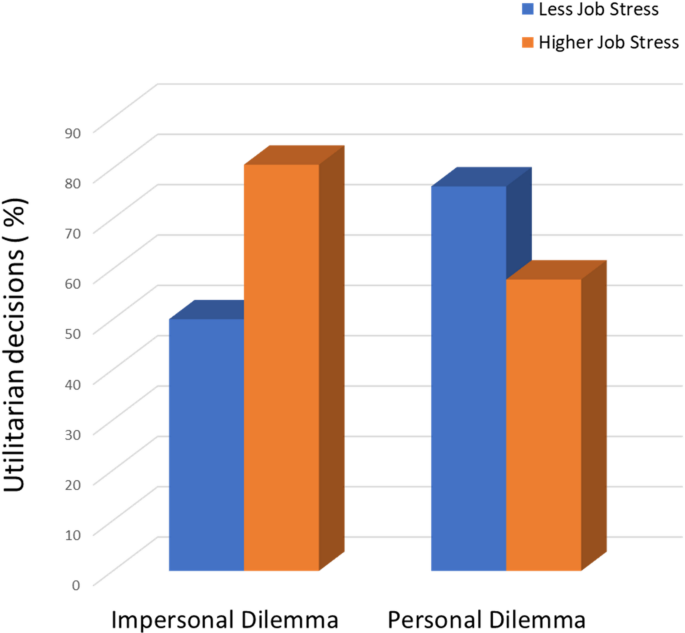
H2 – Greater job stress, particularly indicated by shorter sleep duration and lower perceived job security, will be associated with more utilitarian responses in impersonal moral dilemmas (IMD). Stress may impair emotional regulation and empathy, thus prompting more outcome-focused judgments in scenarios that are emotionally neutral.
H3 – Lower levels of client-related burnout will correspond with a higher likelihood of utilitarian decisions in personal moral dilemmas (PMD). While TMT suggests that mortality cues under stress provoke defensive, deontological responses, those experiencing less burnout may be more capable of engaging in reflective, deliberate reasoning—what McAdams and de St. Aubin describe as “death reflection”26—which can promote generativity and prosocial risk-taking, even in emotionally charged situations.
Understanding how empathy and job stress shape moral choices in healthcare settings is critical for informing institutional policy and training. While this study does not take a normative stance on whether utilitarianism is the ethically superior approach, we assume that the capacity to make impartial, outcome-focused decisions can be especially important in public health crises where resources are limited and trade-offs are inevitable. Identifying factors that influence such decision-making can help institutions better support HCWs’ ethical reasoning and psychological resilience under pressure.
link
:max_bytes(150000):strip_icc()/GettyImages-1353223720-6aa033a7c6414debbec9dbe02bdaeb63.jpg "What Is the Holmes and Rahe Stress Scale?")