
Towards bioelectric signal-enabled human healthcare monitoring: state-of-the-art, design strategies, challenge, and future
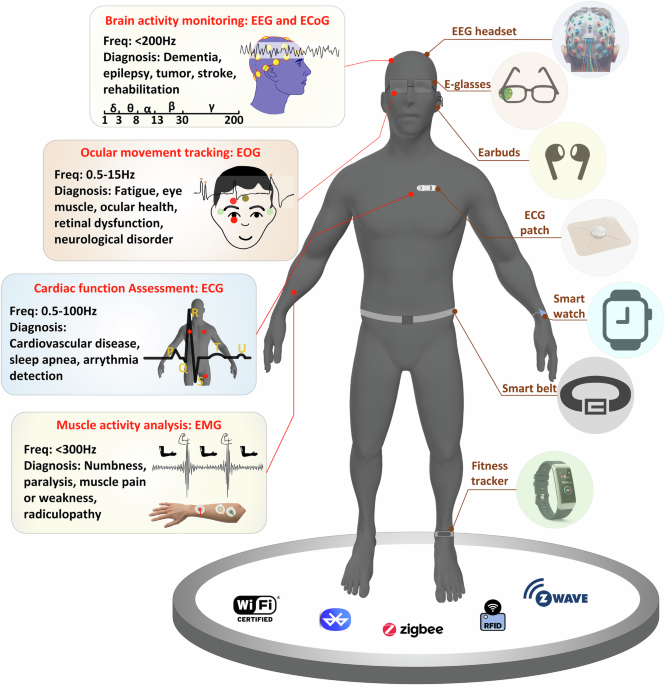
Chen, C., Ding, S. & Wang, J. Digital health for aging populations. Nat. Med. 29, 1623–1630 (2023).
Google Scholar
van Hoogstraten, L. M. et al. Global trends in the epidemiology of bladder cancer: challenges for public health and clinical practice. Nat. Rev. Clin. Oncol. 20, 287–304 (2023).
Google Scholar
Lazarus, J. V. et al. Advancing the global public health agenda for nafld: a consensus statement. Nat. Rev. Gastroenterol. Hepatol. 19, 60–78 (2022).
Google Scholar
WHO. Cardiovascular diseases (cvds) (2021).
WHO. Cancer (2021).
Lin, X. et al. Global, regional, and national burden and trend of diabetes in 195 countries and territories: an analysis from 1990 to 2025. Sci. Rep. 10, 1–11 (2020).
Zhou, B., Perel, P., Mensah, G. A. & Ezzati, M. Global epidemiology, health burden and effective interventions for elevated blood pressure and hypertension. Nat. Rev. Cardiol. 18, 785–802 (2021).
Google Scholar
Münzel, T., Sørensen, M., Hahad, O., Nieuwenhuijsen, M. & Daiber, A. The contribution of the exposome to the burden of cardiovascular disease. Nat. Rev. Cardiol. 20, 651–669 (2023).
Google Scholar
Thijs, R. D., Ryvlin, P. & Surges, R. Autonomic manifestations of epilepsy: emerging pathways to sudden death?. Nat. Rev. Neurol. 17, 774–788 (2021).
Google Scholar
Martyushev-Poklad, A., Yankevich, D. & Petrova, M. Improving the effectiveness of healthcare: diagnosis-centered care vs. person-centered health promotion, a long forgotten new model. Front. Public Health 10, 819096 (2022).
Google Scholar
Anikwe, C. V. et al. Mobile and wearable sensors for data-driven health monitoring system: state-of-the-art and future prospect. Expert Syst. Appl. 202, 117362 (2022).
Google Scholar
Sivaranjani, S., Vinoth Kumar, P. & Palanivel Rajan, S. Health monitoring and integrated wearables. In Augmented Intelligence in Healthcare: A Pragmatic and Integrated Analysis, 41–61 (Springer, 2022).
Hamzah, A. A. & Nadzirah, S. Biosensor Development (Elsevier, 2023).
Abuzeid, H. R., Abdelaal, A. F., Elsharkawy, S. & Ali, G. A. Basic principles and applications of biological sensors technology. In Handbook of Nanosensors: Materials and Technological Applications, 1–45 (Springer, 2023).
Das, P., Das, M., Chinnadayyala, S. R., Singha, I. M. & Goswami, P. Recent advances on developing 3rd generation enzyme electrode for biosensor applications. Biosens. Bioelectron. 79, 386–397 (2016).
Google Scholar
Jin, X., Liu, C., Xu, T., Su, L. & Zhang, X. Artificial intelligence biosensors: challenges and prospects. Biosens. Bioelectron. 165, 112412 (2020).
Google Scholar
Lee, J. H. et al. 3D printed, customizable, and multifunctional smart electronic eyeglasses for wearable healthcare systems and human–machine interfaces. ACS Appl. Mater. interfaces 12, 21424–21432 (2020).
Google Scholar
Masoumian Hosseini, M., Masoumian Hosseini, S. T., Qayumi, K., Hosseinzadeh, S. & Sajadi Tabar, S. S. Smartwatches in healthcare medicine: assistance and monitoring; a scoping review. BMC Med. Inform. Decis. Mak. 23, 248 (2023).
Google Scholar
Ghosh, J., Mani, M., Arvind, H. & Sharmila, N. IoT based real time smart patient monitoring vest. In 2020 4th International Conference on Intelligent Computing and Control Systems (ICICCS), 193–198 (IEEE, 2020).
Tlili, F., Haddad, R., Bouallegue, R. & Shubair, R. Design and architecture of smart belt for real time posture monitoring. Internet Things 17, 100472 (2022).
Google Scholar
Pillai, S., Upadhyay, A., Sayson, D., Nguyen, B. H. & Tran, S. D. Advances in medical wearable biosensors: design, fabrication and materials strategies in healthcare monitoring. Molecules 27, 165 (2021).
Google Scholar
Mishra, S. & Deshmukh, R. Overview of advancement in biosensing technology, including its applications in healthcare. Curr. Pharm. Biotechnol. 24, 411–426 (2023).
Google Scholar
Prabhu, S. N., Gooneratne, C. P., Hoang, K.-A. & Mukhopadhyay, S. C. IoT-associated impedimetric biosensing for point-of-care monitoring of kidney health. IEEE Sens. J. 21, 14320–14329 (2020).
Google Scholar
Zeng, X., Peng, R., Fan, Z. & Lin, Y. Self-powered and wearable biosensors for healthcare. Mater. Today Energy 23, 100900 (2022).
Google Scholar
Yang, L., Amin, O. & Shihada, B. Intelligent wearable systems: opportunities and challenges in health and sports. ACM Comput. Surv. (2024).
Arakawa, T., Dao, D. V. & Mitsubayashi, K. Biosensors and chemical sensors for healthcare monitoring: a review. IEEJ Trans. Electr. Electron. Eng. 17, 626–636 (2022).
Google Scholar
Smith, A. A., Li, R. & Tse, Z. T. H. Reshaping healthcare with wearable biosensors. Sci. Rep. 13, 4998 (2023).
Google Scholar
Kim, E. R., Joe, C., Mitchell, R. J. & Gu, M. B. Biosensors for healthcare: current and future perspectives. Trends Biotechnol. 41, 374–395 (2023).
Google Scholar
Kulkarni, M. B., Rajagopal, S., Prieto-Simón, B. & Pogue, B. W. Recent advances in smart wearable sensors for continuous human health monitoring. Talanta 272, 125817 (2024).
Google Scholar
Li, Z., Tian, X., Qiu, C.-W. & Ho, J. S. Metasurfaces for bioelectronics and healthcare. Nat. Electron. 4, 382–391 (2021).
Google Scholar
Tatum, W. O. Handbook of EEG Interpretation (Springer Publishing Company, 2021).
Beniczky, S. & Schomer, D. Electroencephalography: basic biophysical and technological aspects important for clinical applications. Epileptic Disord. 22, 697–715 (2020).
Buzsáki, G., Anastassiou, C. A. & Koch, C. The origin of extracellular fields and currents-EEG, ECoG, LFP and spikes. Nat. Rev. Neurosci. 13, 407–420 (2012).
Google Scholar
Schalk, G. & Leuthardt, E. C. Brain-computer interfaces using electrocorticographic signals. IEEE Rev. Biomed. Eng. 4, 140–154 (2011).
Google Scholar
Dey, N., Ashour, A. S., Shi, F., Fong, S. J. & Sherratt, R. S. Developing residential wireless sensor networks for ECG healthcare monitoring. IEEE Trans. Consum. Electron. 63, 442–449 (2017).
Google Scholar
Sun, J. et al. A low-pass filter of 300 hz improved the detection of pacemaker spike on remote and bedside electrocardiogram. Chin. Med. J. 132, 534–541 (2019).
Google Scholar
Chang, W.-D. Electrooculograms for human–computer interaction: a review. Sensors 19, 2690 (2019).
Google Scholar
Singh, H. & Singh, J. Human eye tracking and related issues: a review. Int. J. Sci. Res. Publ. 2, 1–9 (2012).
Martinek, R. et al. Advanced bioelectrical signal processing methods: past, present, and future approach-part iii: other biosignals. Sensors 21, 6064 (2021).
Google Scholar
Bulling, A., Ward, J. A., Gellersen, H. & Tröster, G. Eye movement analysis for activity recognition using electrooculography. IEEE Trans. Pattern Anal. Mach. Intell. 33, 741–753 (2011).
Google Scholar
Benatti, S. et al. Emg acquisition and processing for hand movement decoding on embedded systems: state of the art and challenges. Proc. IEEE 113, 256–286 (2025).
Google Scholar
Beretta-Piccoli, M., Cescon, C. & D’Antona, G. Evaluation of performance fatigability through surface EMG in health and muscle disease: state of the art. Arab J. Basic Appl. Sci. 28, 21–40 (2021).
Kamata, K., Aho, A., Hagihira, S., Yli-Hankala, A. & Jäntti, V. Frequency band of EMG in anaesthesia monitoring. Br. J. Anaesth. 107, 822–823 (2011).
Google Scholar
Karacan, I. & Türker, K. S. A comparison of electromyography techniques: surface versus intramuscular recording. Eur. J. Appl. Physiol. 125, 7–23 (2025).
Google Scholar
Muceli, S. & Merletti, R. Tutorial. frequency analysis of the surface EMG signal: best practices. J. Electromyogr. Kinesiol. 79, 102937 (2024).
Google Scholar
Stegeman, D. F., Kleine, B. U., Lapatki, B. G. & Van Dijk, J. P. High-density surface EMG: techniques and applications at a motor unit level. Biocybern. Biomed. Eng. 32, 3–27 (2012).
Google Scholar
Polachan, K., Chatterjee, B., Weigand, S. & Sen, S. Human body–electrode interfaces for wide-frequency sensing and communication: a review. Nanomaterials 11, 2152 (2021).
Google Scholar
Lee, M. S., Paul, A., Xu, Y., Hairston, W. D. & Cauwenberghs, G. Characterization of Ag/AgCI dry electrodes for wearable electrophysiological sensing. Front. Electron. 2, 700363 (2022).
Google Scholar
Nescolarde, L. et al. Different displacement of bioimpedance vector due to Ag/AgCl electrode effect. Eur. J. Clin. Nutr. 70, 1401–1407 (2016).
Google Scholar
Yang, L. et al. Insight into the contact impedance between the electrode and the skin surface for electrophysical recordings. ACS Omega 7, 13906–13912 (2022).
Google Scholar
Kappenman, E. S. & Luck, S. J. The effects of electrode impedance on data quality and statistical significance in ERP recordings. Psychophysiology 47, 888–904 (2010).
Google Scholar
Hassan, Z. et al. Design of dry electrodes and impedance variations across different electrostimulation modalities. J. Ind. Text. 55, 15280837251346787 (2025).
Google Scholar
Joutsen, A. et al. ECG signal quality in intermittent long-term dry electrode recordings with controlled motion artifacts. Sci. Rep. 14, 8882 (2024).
Google Scholar
Jiang, Y. & Soleimani, M. Capacitively coupled phase-based dielectric spectroscopy tomography. Sci. Rep. 8, 17526 (2018).
Google Scholar
Sankar, V. et al. Electrode impedance analysis of chronic tungsten microwire neural implants: understanding abiotic vs. biotic contributions. Front. Neuroeng. 7, 13 (2014).
Google Scholar
Wei, X. F. & Grill, W. M. Impedance characteristics of deep brain stimulation electrodes in vitro and in vivo. J. Neural Eng. 6, 046008 (2009).
Google Scholar
Shad, E. H. T., Molinas, M. & Ytterdal, T. Impedance and noise of passive and active dry EEG electrodes: a review. IEEE Sens. J. 20, 14565–14577 (2020).
Google Scholar
Saadeh, W., Altaf, M. A. B., Alsuradi, H. & Yoo, J. A 1.1-mw ground effect-resilient body-coupled communication transceiver with pseudo OFDM for head and body area network. IEEE J. Solid-State Circuits 52, 2690–2702 (2017).
Google Scholar
Jang, J. et al. A four-camera VGA-resolution capsule endoscope system with 80-Mb/s body channel communication transceiver and sub-centimeter range capsule localization. IEEE J. Solid-State Circuits 54, 538–549 (2019).
Google Scholar
Lee, J., Lee, G.-H., Kim, H. & Cho, S. An ultra-high input impedance analog front end using self-calibrated positive feedback. IEEE J. Solid State Circuits 53, 2252–2262 (2018).
Google Scholar
Bai, W., Zhu, Z., Li, Y. & Liu, L. A 64.8μW > 2.2GΩ DC–AC configurable CMOS front-end IC for wearable ECG monitoring. IEEE Sens. J. 18, 3400–3409 (2018).
Google Scholar
Vafaei, M., Parhizgar, A., Abiri, E. & Salehi, M. R. A low power and ultra-high input impedance analog front end based on fully differential difference inverter-based amplifier for biomedical applications. AEU Int. J. Electron. Commun. 142, 154005 (2021).
Google Scholar
Maji, S. & Burke, M. J. A bootstrapping technique to boost input impedance of ECG recording amplifiers. In 2022 IEEE International Instrumentation and Measurement Technology Conference (I2MTC), 1–6 (IEEE, 2022).
Fan, Q., Sebastiano, F., Huijsing, J. H. & Makinwa, K. A. A. A 1.8 μw 60 nv/√ hz capacitively-coupled chopper instrumentation amplifier in 65 nm cmos for wireless sensor nodes. IEEE J. Solid State Circuits 46, 1534–1543 (2011).
Google Scholar
Chang, C.-H. et al. An analog front-end chip with self-calibrated input impedance for monitoring of biosignals via dry electrode-skin interfaces. IEEE Trans. Circ. Syst. I Regul. Pap. 64, 2666–2678 (2017).
Google Scholar
Rasekh, A. & Bakhtiar, M. S. Compensation method for multistage opamps with high capacitive load using negative capacitance. IEEE Trans. Circ. Syst. II Express Briefs 63, 919–923 (2016).
Liang, Z., Li, B., Wu, Z. & Hu, Y. A high input impedance chopper amplifier using negative impedance convertor for implantable EEG recording. IEICE Electron. Express 17, 20200238–20200238 (2020).
Google Scholar
Chandrakumar, H. & Marković, D. An 80-mVpp linear-input range, 1.6- Gω input impedance, low-power chopper amplifier for closed-loop neural recording that is tolerant to 650-mVpp common-mode interference. IEEE J. Solid State Circuits 52, 2811–2828 (2017).
Chi, Y. M., Maier, C. & Cauwenberghs, G. Ultra-high input impedance, low noise integrated amplifier for noncontact biopotential sensing. IEEE J. Emerg. Sel. Top. Circuits Syst. 1, 526–535 (2011).
Google Scholar
Saadeh, W., Alsuradi, H., Altaf, M. A. B. & Yoo, J. A 1.1mW hybrid OFDM ground effect-resilient body coupled communication transceiver for head and body area network. In 2016 IEEE Asian Solid-State Circuits Conference, A-SSCC 2016 – Proceedings, 201–204 (IEEE, 2017).
Alonso, E., Giannetti, R., Rodríguez-Morcillo, C., Matanza, J. & Muñoz-Frías, J. D. A novel passive method for the assessment of skin-electrode contact impedance in intraoperative neurophysiological monitoring systems. Sci. Rep. 10, 2819 (2020).
Google Scholar
Aftab, M., Shah, S. A. A., Aslam, A. R., Saadeh, W. & Altaf, M. A. B. Design of energy-efficient electrocorticography recording system for intractable epilepsy in implantable environments. In 2020 IEEE International Symposium on Circuits and Systems (ISCAS), 1–5 (IEEE, 2020).
Hooge, F. & Bobbert, P. On the correlation function of 1/f noise. Phys. B Condens. Matter 239, 223–230 (1997).
Google Scholar
Kim, K. et al. Magnetoresistive biosensors with on-chip pulsed excitation and magnetic correlated double sampling. Sci. Rep. 8, 16493 (2018).
Google Scholar
Klumperink, E., Gierkink, S., van der Wel, A. & Nauta, B. Reducing mosfet 1/f noise and power consumption by switched biasing. IEEE J. Solid State Circ. 35, 994–1001 (2000).
Google Scholar
Sheeraz, M., Saadeh, W. & Altaf, M. A. B. A wearable EEG acquisition device with flexible silver ink screen printed dry sensors. In 2023 IEEE International Symposium on Circuits and Systems (ISCAS), 1–5 (IEEE, 2023).
Hornero, G., Casas, O. & Areny, R. P. Common mode response effects in differential measurements. AEU Int. J. Electron. Commun. 128, 153510 (2021).
Google Scholar
Sawan, M., Salam, M. T., Le Lan, J. et al. Wireless recording systems: from noninvasive EEG-NIRS to invasive EEG devices. IEEE Trans. Biomed. Circ. Syst. 7, 186–195 (2013).
Google Scholar
Gao, Y. et al. Heart monitor using flexible capacitive ECG electrodes. IEEE Trans. Instrum. Meas. 69, 4314–4323 (2019).
Google Scholar
Analog Devices. AD8421: low noise, low power, rail-to-rail instrumentation amplifier. Data Sheet, Rev. A (2011).
Zhou, X. et al. A wearable EAR-EEG recording system based on dry-contact active electrodes. In 2016 IEEE Symposium on VLSI Circuits (VLSI-Circuits), 1–2 (IEEE, 2016).
Acharya, V. Improving Common-Mode Rejection Using the Right-Leg Drive Amplifier. Texas Instruments. Application Report SBAA188. (2011).
Choi, K.-J. & Sim, J.-Y. A time-division multiplexed 8-channel non-contact ECG recording IC with a common-mode interference tolerance of 20 Vpp. In 2022 IEEE International Solid-State Circuits Conference (ISSCC), 65, 1–3 (IEEE, 2022).
Usakli, A. B. & Gurkan, S. Design of a novel efficient human–computer interface: an electrooculagram based virtual keyboard. IEEE Trans. Instrum. Meas. 59, 2099–2108 (2009).
Google Scholar
Chen, X.-B., Zhou, Y.-X., Wang, H.-P., Lü, X.-Y. & Wang, Z.-G. Design of sEMG-detecting circuit for EMG-bridge. In 2017 39th Annual International Conference of the IEEE Engineering in Medicine and Biology Society (EMBC), 382–385 (IEEE, 2017).
Golparvar, A. J. & Yapici, M. K. Electrooculography by wearable graphene textiles. IEEE Sens. J. 18, 8971–8978 (2018).
Google Scholar
Ozkan, H. et al. A portable wearable tele-ECG monitoring system. IEEE Trans. Instrum. Meas. 69, 173–182 (2019).
Google Scholar
Park, Y. et al. A real-time depth of anesthesia monitoring system based on deep neural network with large EDO tolerant EEG analog front-end. IEEE Trans. Biomed. Circuits Syst. 14, 825–837 (2020).
Google Scholar
Chen, P.-W., Huang, C.-W. & Wu, C.-Y. An 1.97μ, W/Ch 65nm-CMOS 8-channel analog front-end acquisition circuit with fast-settling hybrid DC servo loop for EEG monitoring. In 2018 IEEE International Symposium on Circuits and Systems (ISCAS), 1–5 (IEEE, 2018).
Liu, L., Chen, X. & Pan, F. A review on electromagnetic shielding magnesium alloys. J. Magnes. Alloy. 9, 1906–1921 (2021).
Google Scholar
g.tec Medical Engineering GmbH. g.Hiamp 256-Channel Biosignal Amplifier. (2025).
ADInstruments. Bio amps – galvanically isolated differential amplifiers for ECG, EEG, EMG, and EOG. (2025).
Kamble, R. S. & Kuntawar, S. V. Removal of artifacts from ECG signal using RLS based adaptive filter. Int. J. Comput. Appl. 975, 8887 (2016).
Chen, X., He, C. & Peng, H. Removal of muscle artifacts from single-channel EEG based on ensemble empirical mode decomposition and multiset canonical correlation analysis. J. Appl. Math. 2014, 261347 (2014).
Raggi, M. & Mesin, L. Denoising the ECG from the emg using stationary wavelet transform and template matching. Electronics 14, 3474 (2025).
Google Scholar
Teng, C.-L. et al. A novel method based on combination of independent component analysis and ensemble empirical mode decomposition for removing electrooculogram artifacts from multichannel electroencephalogram signals. Front. Neurosci. 15, 729403 (2021).
Google Scholar
Sweeney, K. T., McLoone, S. F. & Ward, T. E. The use of ensemble empirical mode decomposition with canonical correlation analysis as a novel artifact removal technique. IEEE Trans. Biomed. Eng. 60, 97–105 (2012).
Google Scholar
Bae, J., Song, K., Lee, H., Cho, H. & Yoo, H.-J. A 0.24-nj/b wireless body-area-network transceiver with scalable double-FSK modulation. IEEE J. Solid State Circ. 47, 310–322 (2012).
Google Scholar
Jang, J., Lee, J., Cho, H., Lee, J. & Yoo, H.-J. Wireless body-area-network transceiver and low-power receiver with high application expandability. IEEE J. Solid-State Circuits 55, 2781–2789 (2020).
Google Scholar
Shin, Y., Seomun, J., Choi, K.-M. & Sakurai, T. Power gating: Circuits, design methodologies, and best practice for standard-cell vlsi designs. ACM Trans. Des. Autom. Electron. Syst. 15 (2010).
Rojas, G. et al. Study of resting-state functional connectivity networks using EEG electrodes position as seed. Front. Neurosci. 12, 235 (2018).
Koessler, L. et al. Automated cortical projection of EEG sensors: anatomical correlation via the international 10–10 system. Neuroimage 46, 64–72 (2009).
Google Scholar
Zaveri, H. P., Duckrow, R. B. & Spencer, S. S. On the use of bipolar montages for time-series analysis of intracranial electroencephalograms. Clin. Neurophysiol. 117, 2102–2108 (2006).
Google Scholar
Ruiz, R. A. S., Ranta, R. & Louis-Dorr, V. EEG montage analysis in the blind source separation framework. Biomed. Signal Process. control 6, 77–84 (2011).
Google Scholar
Sazgar, M. & Young, M. G. Overview of EEG, Electrode Placement, and Montages, 117–125 (Springer International Publishing, 2019).
Gao, K.-P., Shen, G.-C., Zhao, N. et al. Wearable multifunction sensor for the detection of forehead EEG signal and sweat rate on skin simultaneously. IEEE Sens. J. 20, 10393–10404 (2020).
Google Scholar
Looney, D. et al. The in-the-ear recording concept: user-centered and wearable brain monitoring. IEEE pulse 3, 32–42 (2012).
Google Scholar
Lee, J. H. et al. CNT/PDMS-based canal-typed ear electrodes for inconspicuous EEG recording. J. Neural Eng. 11, 046014 (2014).
Google Scholar
Kaveh, R. et al. Wireless user-generic ear EEG. IEEE Trans. Biomed. Circ. Syst. 14, 727–737 (2020).
Google Scholar
Goverdovsky, V., Looney, D., Kidmose, P. & Mandic, D. P. In-ear EEG from viscoelastic generic earpieces: robust and unobtrusive 24/7 monitoring. IEEE Sens. J. 16, 271–277 (2016).
Google Scholar
Kappel, S. L., Rank, M. L., Toft, H. O. et al. Dry-contact electrode ear-EEG. IEEE Trans. Biomed. Eng. 66, 150–158 (2018).
Google Scholar
Wu, C.-Y., Cheng, C.-H. & Chen, Z.-X. A 16-channel CMOS chopper-stabilized analog front-end ECoG acquisition circuit for a closed-loop epileptic seizure control system. IEEE Trans. Biomed. Circuits Syst. 12, 543–553 (2018).
Google Scholar
Zhang, F., Mishra, A., Richardson, A. G. & Otis, B. A low-power ECoG/EEG processing IC with integrated multiband energy extractor. IEEE Trans. Circuits Syst. I Regul. Pap. 58, 2069–2082 (2011).
Google Scholar
Pistor, J. et al. Development of a fully implantable recording system for ECoG signals. In 2013 Design, Automation & Test in Europe Conference & Exhibition (DATE), 893–898 (IEEE, 2013).
Charvet, G. et al. WIMAGINE: a wireless, low power, 64-channel ECoG recording platform for implantable BCI applications. In 2011 5th International IEEE/EMBS Conference on Neural Engineering, 356–359 (IEEE, 2011).
Rajbhandary, P. L., Nallathambi, G., Selvaraj, N., Tran, T. & Colliou, O. ECG signal quality assessments of a small bipolar single-lead wearable patch sensor. Cardiovasc. Eng. Technol. 13, 783–796 (2022).
Google Scholar
Rahman, M. A. et al. Miniaturized 3-lead electrocardiogram system based on einthoven triangle for wireless cardiac care monitoring. Adv. Intell. Syst. 6, 2300659 (2024).
Google Scholar
Schmidt-Lucke, C. et al. Validation of the artificial intelligence-based 5-lead 3D vectorcardiography in comparison to the 12-lead ECG in a mixed population. Circulation 148, A16473–A16473 (2023).
Google Scholar
Yuan, L., Yuan, Y., Zhou, Z., Bai, Y. & Wu, S. A fetal ECG monitoring system based on the android smartphone. Sensors 19, 446 (2019).
Google Scholar
Lee, J.-H. & Seo, D.-W. Development of ECG monitoring system and implantable device with wireless charging. Micromachines 10, 38 (2019).
Google Scholar
Chen, Q., Kastratovic, S., Eid, M. & Ha, S. A non-contact compact portable ECG monitoring system. Electronics 10, 2279 (2021).
Google Scholar
Xu, J. et al. A 0.6 v 3.8 μw ECG/bio-impedance monitoring ic for disposable health patch in 40nm CMOS. In 2018 IEEE Custom Integrated Circuits Conference (CICC), 1–4 (IEEE, 2018).
Tasneem, N. T., Pullano, S. A., Critello, C. D., Fiorillo, A. S. & Mahbub, I. A low-power on-chip ECG monitoring system based on mwcnt/pdms dry electrodes. IEEE Sens. J. 20, 12799–12806 (2020).
Google Scholar
Liu, L., He, L., Zhang, Y. & Hua, T. A battery-less portable ECG monitoring system with wired audio transmission. IEEE Trans. Biomed. Circuits Syst. 13, 697–709 (2019).
Google Scholar
Ahmadibakhsh, F., Afdideh, F. & Resalat, S. N. A new hardware implementation of motor control using EOG signals. In 2012 IEEE-EMBS Conference on Biomedical Engineering and Sciences, 746–749 (IEEE, 2012).
Keskinoğlu, C. & AYDIN, A. EOG-based computer control system for people with mobility limitations. Eur. J. Sci. Technol. 26, 256–261 (2021).
Haslwanter, T. & Clarke, A. H. Chapter 5 – eye movement measurement: electro-oculography and video-oculography. In Vertigo and Imbalance: Clinical Neurophysiologyof the Vestibular System, vol. 9 of Handbook of Clinical Neurophysiology, 61–79 (Elsevier, 2010). https://www.sciencedirect.com/science/article/pii/S1567423110090052.
Rojas, M., Ponce, P. & Molina, A. Development of a sensing platform based on hands-free interfaces for controlling electronic devices. Front. Hum. Neurosci. 16, 867377 (2022).
Google Scholar
Merletti, R. & Cerone, G. Tutorial. surface EMG detection, conditioning and pre-processing: best practices. J. Electromyogr. Kinesiol. 54, 102440 (2020).
Google Scholar
Tam, S. et al. A wearable wireless armband sensor for high-density surface electromyography recording. In 2019 41st Annual International Conference of the IEEE Engineering in Medicine and Biology Society (EMBC), 6040–6044 (IEEE, 2019).
Ng, C. L., Reaz, M. B. I. & Chowdhury, M. E. H. A low noise capacitive electromyography monitoring system for remote healthcare applications. IEEE Sens. J. 20, 3333–3342 (2020).
Google Scholar
Naim, A. M. et al. Low-cost active dry-contact surface EMG sensor for bionic arms. In 2020 IEEE International Conference on Systems, Man, and Cybernetics (SMC), 3327–3332 (2020).
Shafti, A., Ribas Manero, R. B., Borg, A. M., Althoefer, K. & Howard, M. J. Embroidered electromyography: a systematic design guide. IEEE Trans. Neural Syst. Rehabilit. Eng. 25, 1472–1480 (2017).
Google Scholar
Liu, X. et al. The PennBMBI: design of a general purpose wireless brain-machine-brain interface system. IEEE Trans. Biomed. Circuits Syst. 9, 248–258 (2015).
Google Scholar
Edelman, B. J. et al. Non-invasive brain-computer interfaces: state of the art and trends. IEEE Rev. Biomed. Eng. 18, 26–49 (2024).
Leuthardt, E. C., Schalk, G., Roland, J., Rouse, A. & Moran, D. W. Evolution of brain-computer interfaces: going beyond classic motor physiology. Neurosurg. Focus 27, E4 (2009).
Google Scholar
Mahmood, M. et al. Fully portable and wireless universal brain–machine interfaces enabled by flexible scalp electronics and deep learning algorithm. Nat. Mach. Intell. 1, 412–422 (2019).
Google Scholar
Ha, S. et al. Silicon-integrated high-density electrocortical interfaces. Proc. IEEE 105, 11–33 (2016).
Google Scholar
Luu, D. K. et al. Artificial intelligence enables real-time and intuitive control of prostheses via nerve interface. IEEE Trans. Biomed. Eng. 69, 3051–3063 (2022).
Willett, F. R., Avansino, D. T., Hochberg, L. R., Henderson, J. M. & Shenoy, K. V. High-performance brain-to-text communication via handwriting. Nature 593, 249–254 (2021).
Google Scholar
Dutta, B. Eavesdropping on the brain: with 10,000 electrodes, this neural implant senses more than ever before. IEEE Spectr. 59, 30–35 (2022).
Google Scholar
Huang, Q. et al. Human body communication transceivers. Nat. Rev. Electrical Eng. 2, 374–389 (2025).
Zimmerman, T. G. Personal area networks: near-field intrabody communication. IBM Syst. J. 35, 609–617 (1996).
Google Scholar
Maity, S., Chatterjee, B., Chang, G. & Sen, S. Bodywire: a 6.3-pj/b 30-mb/s-30-db sir-tolerant broadband interference-robust human body communication transceiver using time domain interference rejection. IEEE J. Solid State Circ. 54, 2892–2906 (2019).
Google Scholar
Huang, Q., Sarkar, S. & Sen, S. Enhancing physical security of body resonance human body communication. IEEE Transactions on Antennas and Propagation 1–1 (IEEE, 2025).
Maity, S., Das, D. & Sen, S. Wearable health monitoring using capacitive voltage-mode human body communication. In 2017 39th Annual International Conference of the IEEE Engineering in Medicine and Biology Society (EMBC), 1–4 (IEEE, 2017).
Huang, Q., Alkhayer, W., Fouda, M. E., Celik, A. & Eltawil, A. M. Wearable vital signal monitoring prototype based on capacitive body channel communication. In 2022 IEEE-EMBS International Conference on Wearable and Implantable Body Sensor Networks (BSN), 1–5 (IEEE, 2022).
Sawatari, Y., Wang, J. & Anzai, D. Blood pressure estimation system using human body communication-based electrocardiograph and photoplethysmography. Healthc. Technol. Lett. 7, 98–102 (2020).
Google Scholar
Kim, D.-H. et al. Epidermal electronics. Science 333, 838–843 (2011).
Google Scholar
NF, M. A. L. S. C. Inflammation-free, gas-permeable, lightweight, stretchable on-skin electronics with nanomeshes. Nat. Nanotechnol. 12, 907 (2017).
Google Scholar
Yokota, T. et al. Ultraflexible organic photonic skin. Sci. Adv. 2, e1501856 (2016).
Google Scholar
Yokota, T. et al. Air-stable ultra-flexible organic photonic system for cardiovascular monitoring. Adv. Mater. Technol. 7, 2200454 (2022).
Lee, S. et al. Nanomesh pressure sensor for monitoring finger manipulation without sensory interference. Science 370, 966–970 (2020).
Google Scholar
Miyamoto, A. et al. Highly precise, continuous, long-term monitoring of skin electrical resistance by nanomesh electrodes. Adv. Healthc. Mater. 11, 2102425 (2022).
Google Scholar
Yan, L., Yoo, J., Kim, B. & Yoo, H.-J. A 0.5-μ vrms 12-μ w wirelessly powered patch-type healthcare sensor for wearable body sensor network. IEEE J. Solid State Circuits 45, 2356–2365 (2010).
Li, J., Dong, Y., Park, J. H. & Yoo, J. Body-coupled power transmission and energy harvesting. Nat. Electron. 4, 530–538 (2021).
Google Scholar
Covaci, C. & Gontean, A. Piezoelectric energy harvesting solutions: a review. Sensors 20, 3512 (2020).
Google Scholar
Liu, H., Zhong, J., Lee, C., Lee, S.-W. & Lin, L. A comprehensive review on piezoelectric energy harvesting technology: materials, mechanisms, and applications. Appl. Phys. Rev. 5, 041306 (2018).
Almarri, N. et al. Self-powered piezoelectric biosensing harvester for intracardiac monitoring. In 2023 IEEE Biomedical Circuits and Systems Conference (BioCAS), 1–4 (IEEE, 2023).
Panda, S. et al. Piezoelectric energy harvesting systems for biomedical applications. Nano Energy 100, 107514 (2022).
Google Scholar
Green, M. et al. Solar cell efficiency tables (version 57). Prog. Photovoltaics Res. Appl. 29, 3–15 (2021).
Google Scholar
Guan, J. et al. On-chip solar power source for self-powered smart microsensors in bulk cmos process. Commun. Eng. 4, 23 (2025).
Google Scholar
Min, J. et al. An autonomous wearable biosensor powered by a perovskite solar cell. Nat. Electron. 6, 630–641 (2023).
Google Scholar
Nozariasbmarz, A. et al. Review of wearable thermoelectric energy harvesting: from body temperature to electronic systems. Appl. Energy 258, 114069 (2020).
Google Scholar
Freer, R. et al. Key properties of inorganic thermoelectric materials-tables (version 1). J. Phys.: Energy 4, 022002 (2022).
Google Scholar
Liang, L. et al. Integration of flexible thermoelectric energy harvesting system for self-powered sensor applications. ACS Appl. Mater. Interfaces 17, 3656–3664 (2025).
Google Scholar
Paradiso, J. & Starner, T. Energy scavenging for mobile and wireless electronics. IEEE Pervasive Comput. 4, 18–27 (2005).
Google Scholar
Biswas, S. & Kim, H. Solar cells for indoor applications: progress and development. Polymers 12, 1338 (2020).
Google Scholar
Scharber, M. C. Efficiency of emerging photovoltaic devices under indoor conditions. Sol. RRL 8, 2300811 (2024).
Google Scholar
Thainiramit, P., Yingyong, P. & Isarakorn, D. Impact-driven energy harvesting: piezoelectric versus triboelectric energy harvesters. Sensors 20, 5828 (2020).
Google Scholar
Arroyo, E., Badel, A., Formosa, F., Wu, Y. & Qiu, J. Comparison of electromagnetic and piezoelectric vibration energy harvesters: model and experiments. Sens. Actuators A Phys. 183, 148–156 (2012).
Google Scholar
Garnica, J., Chinga, R. A. & Lin, J. Wireless power transmission: from far field to near field. Proc. IEEE 101, 1321–1331 (2013).
Google Scholar
Visser, H. J. & Vullers, R. J. M. Rf energy harvesting and transport for wireless sensor network applications: principles and requirements. Proc. IEEE 101, 1410–1423 (2013).
Google Scholar
Hong, S. et al. Wearable thermoelectrics for personalized thermoregulation. Sci. Adv. 5, eaaw0536 (2019).
Google Scholar
Ryu, H., Yoon, H.-J. & Kim, S.-W. Hybrid energy harvesters: toward sustainable energy harvesting. Adv. Mater. 31, 1802898 (2019).
Google Scholar
Zhang, Y., Wang, Y. -s & Song, Y. -s Impedance characteristics for solid Ag/AgCl electrode used as recording electric field generated by vessels in seawater. J. Shanghai Univ. 13, 57–62 (2009).
Google Scholar
Xiong, F. et al. Advancements in dry and semi-dry EEG electrodes: design, interface characteristics, and performance evaluation. AIP Adv. 15, 040703 (2025).
Gao, K.-P. et al. A novel bristle-shaped semi-dry electrode with low contact impedance and ease of use features for EEG signal measurements. IEEE Trans. Biomed. Eng. 67, 750–761 (2020).
Google Scholar
Zhu, Y. et al. A flexible, stable, semi-dry electrode with low impedance for electroencephalography recording. RSC Adv. 14, 34415–34427 (2024).
Google Scholar
Kusche, R., Kaufmann, S. & Ryschka, M. Dry electrodes for bioimpedance measurements-design, characterization and comparison. Biomed. Phys. Eng. Express 5, 015001 (2018).
Google Scholar
Li, J. et al. Non-contact electrocardiogram measuring method based on capacitance coupling electrodes with ultra-high input impedance. Rev. Sci. Instrum. 93, 034101 (2022).
Howlader, M. M., Alam, A. U., Sharma, R. P. & Deen, M. J. Materials analyses and electrochemical impedance of implantable metal electrodes. Phys. Chem. Chem. Phys. 17, 10135–10145 (2015).
Google Scholar
Microprobes for Life Science. Platinum-iridium monopolar electrodes. (2025).
Han, J. et al. Impact of impedance levels on recording quality in flexible neural probes. Sensors 24, 2300 (2024).
Google Scholar
Carneiro, M. R., de Almeida, A. T. & Tavakoli, M. Wearable and comfortable e-textile headband for long-term acquisition of forehead EEG signals. IEEE Sens. J. 20, 15107–15116 (2020).
Google Scholar
Masihi, S. et al. Development of a flexible wireless ECG monitoring device with dry fabric electrodes for wearable applications. IEEE Sens. J. 22, 11223–11232 (2021).
Sahu, M. L., Atulkar, M., Ahirwal, M. K. & Ahamad, A. Iot-enabled cloud-based real-time remote ECG monitoring system. J. Med. Eng. Technol. 45, 473–485 (2021).
Google Scholar
Mack, D. J. et al. An EOG-based, head-mounted eye tracker with 1 khz sampling rate. In 2015 IEEE Biomedical Circuits and Systems Conference (BioCAS), 1–4 (IEEE, 2015).
Milanizadeh, S. & Safaie, J. EOG-based HCI system for quadcopter navigation. IEEE Trans. Instrum. Meas. 69, 8992–8999 (2020).
Google Scholar
Debbarma, S., Nabavi, S. & Bhadra, S. A wireless flexible electrooculogram monitoring system with printed electrodes. In 2021 IEEE International Instrumentation and Measurement Technology Conference (I2MTC), 1–6 (IEEE, 2021).
Fang, Y., Liu, H., Li, G. & Zhu, X. A multichannel surface EMG system for hand motion recognition. Int. J. Humanoid Robot. 12, 1550011 (2015).
Paul, G. M., Cao, F., Torah, R. et al. A smart textile based facial EMG and EOG computer interface. IEEE Sens. J. 14, 393–400 (2014).
Google Scholar
Belkhiria, C., Boudir, A., Hurter, C. & Peysakhovich, V. Eog-based human–computer interface: 2000–2020 review. Sensors 22, 4914 (2022).
Google Scholar
Sun, S., Wang, J. et al. Eye-tracking monitoring based on PMUT arrays. J. Microelectromechanical Syst. 31, 45–53 (2022).
Google Scholar
link